(Item 229)
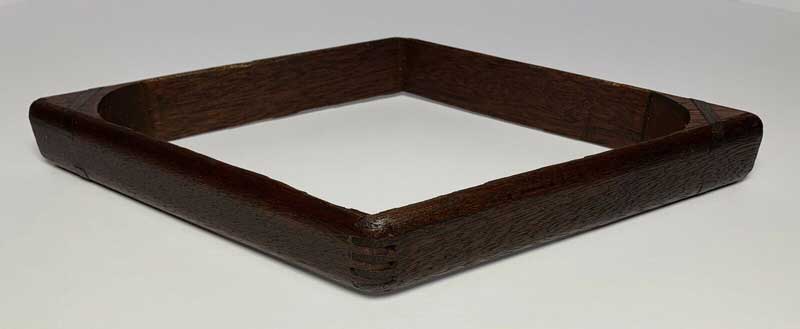
The Antique Mahogany 9-Ball Rack is a remarkable companion to the 15-ball version but it is arguably even more significant for the history of the “short rack” games. In the 1870s, “9-Ball” as we know it today was in its infancy, often played as a faster, gambling-oriented alternative to the marathon 15-ball rotation games.
Finding a diamond-shaped rack from this early period is rare, as many 9-ball games were originally racked in the front of a standard triangle before specialized racks became common.
The Diamond Engineering
While the 15-ball triangle is a naturally stable shape, the 9-ball diamond is prone to “spreading” or losing its acute angles at the top and bottom.
The Spline Advantage: Just like Item 230, the wooden splined corners are the hero of this piece. On a 9-ball rack, the two “side” joints are under immense tension when a player pushes the balls forward to “freeze” them. The spline prevents the mahogany from shearing at the grain.
Mahogany’s “Dead” Weight: Mahogany was chosen not just for its beauty, but for its weight. A slightly heavier rack stays seated on the cloth more effectively, preventing the “rack hop” that can ruin a professional tight-rack.
Historical Context: 1870s Gambling and Speed
In the post-Civil War era, the “9-Ball” game (originally called “9-Ball Pool” or “Diamond Pool”) was often associated with the high-stakes action of urban pool rooms.
The Look: A mahogany rack from this era would have likely been paired with a high-end table in a “Gentleman’s Club” or a private residence. It was a statement that even the “fast” games were to be played with the highest-quality equipment.
The Grain: 1870s Mahogany (often sourced from Honduras or Cuba) has a much tighter grain than modern plantation-grown varieties. This allowed the 19th-century craftsman to sand the inner faces of the rack to a glass-like finish, ensuring the balls wouldn’t snag as the rack was lifted.
Preservation
| Feature | Preservation Check |
| The “Point” Joints | Check the very top and bottom points of the diamond. These are the “impact zones.” If the splines are original, they should be flush with the surface. |
| Finish Integrity | Most 1870s Mahogany was finished with Shellac. If the finish looks “cloudy,” it may have been exposed to moisture. A professional can “re-amalgamate” the shellac without stripping the history. |
| Symmetry | Measure the distance between the side points. Over 150 years, wood can “creep.” A perfect 9-ball diamond from the 1870s that hasn’t warped is a “Museum Grade” survivor. |
The “Twin” Set: Item 229 & 230
Having both the 9-ball and 15-ball racks from the same era, made of the same wood, and utilizing the same splined construction is a curator’s dream. It suggests they may have originated from the same high-end “Room Set” or private estate.
Please email for price .