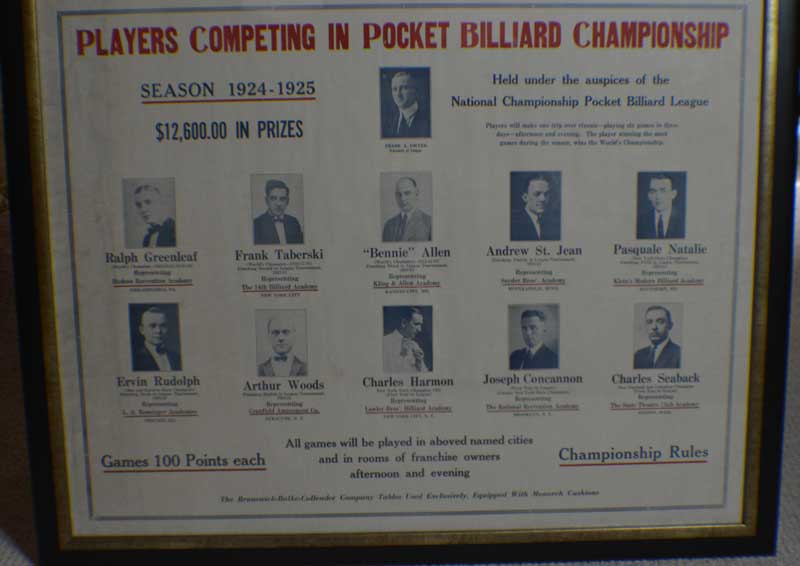
That 1924-1925 Championship poster is a remarkable piece of sports history. In the collecting world, the mid-1920s are considered the “Golden Age” of pocket billiards, and this poster features an absolute “Who’s Who” of the era.
What makes this specific item (Item 219) so significant is the presence of Ralph Greenleaf and Frank Taberski. Their rivalry was the 1920s equivalent of Ali vs. Frazier.
Key Highlights of the Roster
Ralph Greenleaf: Widely considered the greatest pool player of all time. By the 1924-25 season, he was already a multi-time World Champion and a massive celebrity.
Frank Taberski: The “Schenectady Snail,” known for his deliberate, invincible style. He famously came out of retirement in 1925 to reclaim the title from Greenleaf.
Ervin Rudolph: A five-time world champion and the man who invented the “straight pool” high-run style that dominated the mid-century.
The Field: Names like Bennie Allen and Pasquale Natalie represent the elite “circuit” players who traveled the country when pool rooms were the center of American social life.
Value & Investment Potential
Original posters from this era are exceptionally rare because they were printed on acidic paper meant to be pasted in windows or on pool room walls and then discarded after the season.
Rarity: Surviving examples in “Excellent” condition are few and far into the single digits. Most were lost to moisture, light damage, or simply thrown away.
Market Value: Depending on the vibrancy of the lithography and whether it has been professionally linen-backed, an original of this caliber typically ranges from $2,500 to $5,000+ at specialized sports memorabilia auctions.
Investment Appeal: Ephemera featuring Greenleaf has seen a steady climb in value over the last decade. As the “Babe Ruth of Pool,” anything with his name and a verified 1920s date is a blue-chip asset for a billiard historian.
Collector’s Tip
Given the 31″ x 25″ size, ensure it is kept under UV-protective museum glass. The inks used in 1924 are highly susceptible to “fading out,” especially the reds and yellows. If it hasn’t been linen-backed by a professional conservator, that is a step worth considering to stabilize the paper for the next hundred years.