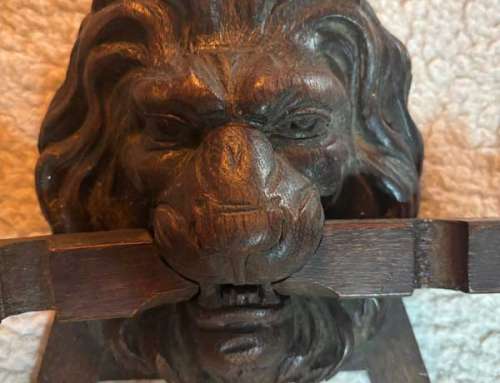
This Item 124 is a centerpiece for any serious billiard historian. While the J.E. Came rack (Item 125) represented Boston elegance, this 1884 Brunswick-Balke-Collender (BBC) rack represents the absolute peak of the American Midwest’s manufacturing might.
Why “1884” and “Black Walnut” Matter
In the early 1880s, the merger between the Brunswick, Balke, and Collender companies was still fresh. During this specific window, they produced some of their most ornate “catalog” pieces to showcase their combined craftsmanship.
The Material: American Black Walnut was the premier luxury wood of the 1880s. It has a tighter grain and deeper color than the oak that would dominate the 1890s. In the late Victorian era, “Black Walnut” was synonymous with wealth and stability.
“Fancy” Carved: In BBC catalogs of the era, the term “Fancy” wasn’t just a descriptor; it often denoted a specific tier of upgrade. This rack likely features hand-carved chamfered edges, scrolled brackets, or incised “Eastlake-style” geometric patterns that elevate it above the standard utility models.
Side-Loading Rarity: As noted in your description, these are extremely rare. Side-loading racks were more expensive to manufacture than front-loading shelves because they required precision-milled grooves and specific tension to keep the balls from rolling out the sides.
Item Profile: #124
| Feature | Detail | Significance |
| Maker | Brunswick-Balke-Collender | The most prestigious name in the history of the game. |
| Date | Circa 1884 | A precise “Golden Era” date; fits perfectly with the Zanzibar Ivory Sets. |
| Design | Side-Loading | Higher technical difficulty; much rarer than standard racks. |
| Dimensions | 33″ x 21″ x 4″ | Deep enough (4″) to house full-size 2 1/4″ balls safely. |
The “Eight Dished Shelves”
Having eight shelves in a rack of this size (33″ tall) means the spacing is tight and visually dense—it makes for a spectacular display when filled with the Double Stripe “Beach Balls” (Item 74/75). The “dishing” (the concave curve of the wood) ensures that even if the wall is slightly unlevel, the balls stay centered and don’t knock into one another.