
(Item 122)
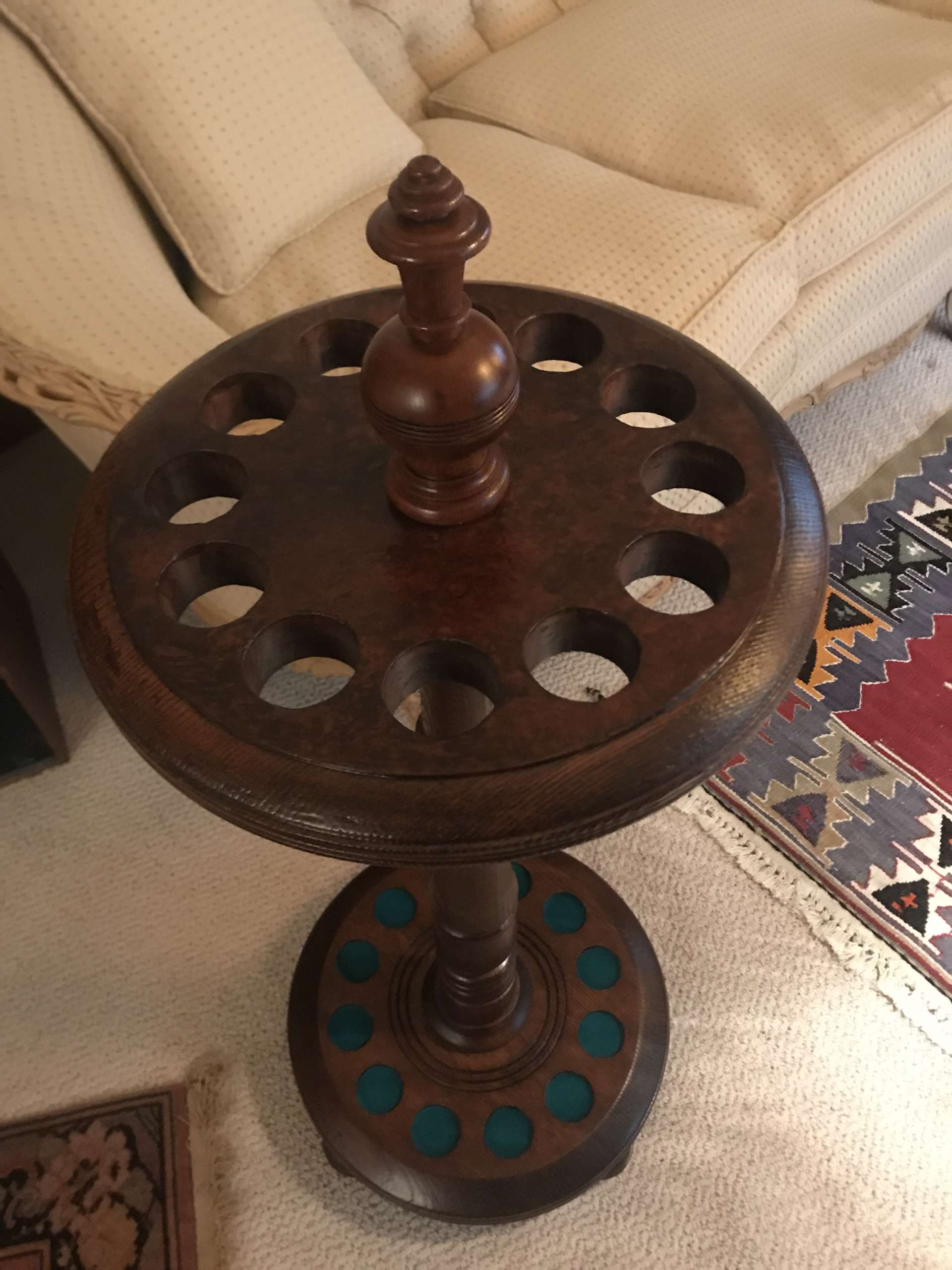
This Free Standing Pool Cue Rack is a standout piece of late 19th-century billiard furniture. While wall-mounted racks were common in commercial parlors to save space, the free-standing “revolving” or “pedestal” style was often the preferred choice for private residences and high-end gentlemen’s clubs.
At 38″ tall, it is perfectly height-scaled for a room where players might be seated in spectator chairs, allowing for easy access to a cue without having to stand up and walk to a wall.
Material and Construction
The Use of Elm: Elm was a sophisticated choice for this period. It is known for its “interlocking grain,” which makes it incredibly difficult to split. In a vertical rack subject to the weight and movement of 12 cues, Elm provided the structural “heaviness” and durability required.
Quarter-Sawn Top Disk: Using quarter-sawn timber for the top disk (where the cue necks rest) is a mark of high quality. Quarter-sawing minimizes wood expansion and contraction, ensuring the cue holes remain perfectly circular and aligned over decades of use.
12-Cue Capacity: This was the classic “domestic” size, designed to hold a full “room set” of cues for a standard 8-foot or 9-foot table.
Restoration and Presence
The Aesthetic: The combination of Elm’s bold grain and the specialized cut of the top disk gives it a distinctive architectural look.
Stability: Unlike wall racks, free-standing racks rely on a weighted base. A Brunswick rack from the 1880s usually features a wide, stable footprint (14″ wide) to prevent the cues from tipping—a common flaw in cheaper, modern reproductions.
Display Tips
Because this rack is 38″ tall, it serves as a “mid-level” visual element in a room. It looks best when placed near the head of the table or between two spectator chairs.
| Maintenance Factor | Advice |
| Cue Weight | To prevent the rack from becoming “top-heavy,” ensure cues are seated firmly in the bottom “cups” or base plate. |
| Rotation | If this is a revolving model, a tiny drop of high-grade clock oil on the center pin can keep the 1880s mechanism spinning silently. |
| Finishing | Since it’s already restored, a simple dusting with a microfiber cloth is all it needs to maintain its luster. |
Collector’s Note
The 1880s was a period of great experimentation for Brunswick-Balke-Collender. Free-standing racks from this decade are significantly rarer than those from the 1910s and 20s, as the company moved toward more standardized, mass-produced wall units in the early 20th century. An Elm-wood BBC rack is a rare “character” piece that adds a lot of warmth to a room. (Sold), Please check with us on others like this.