(Item 120)
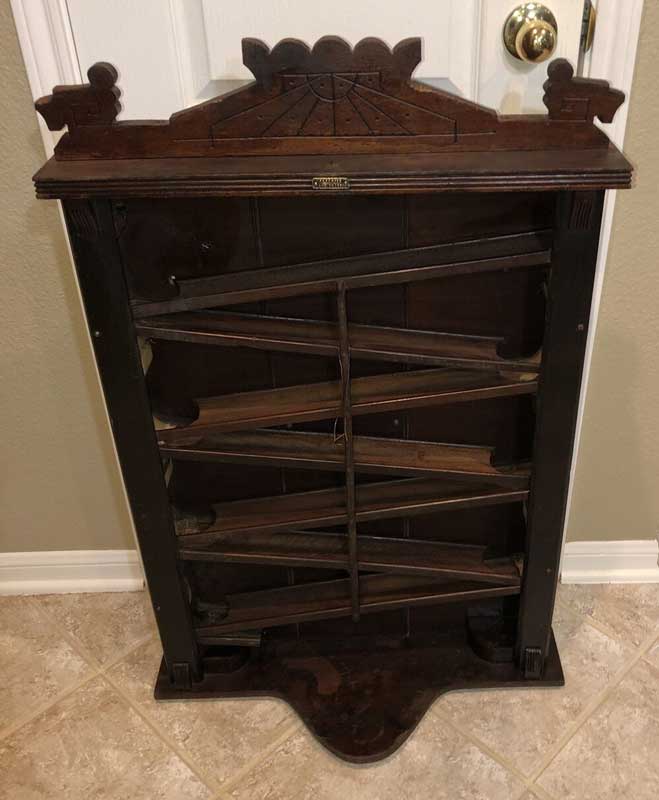
The Whitney’s Patent Mechanical Zig-Zag Rack is a true mechanical marvel from the “Golden Age” of billiard invention. In the 1880s, the J.M. Brunswick & Balke Co. wasn’t just selling tables; they were selling “scientific” improvements to the game, and Whitney’s patent was the ultimate solution for both theater and convenience.
The Engineering: Whitney’s Patent
Before the standardized plastic or wooden wall racks we see today, designers experimented with gravity-fed systems. Whitney’s Zig-Zag design served two main purposes:
Security and Inventory: In commercial parlors, the “rack-boy” or room manager could see at a glance if all 15 balls were present.
The Mechanical Release: Instead of picking balls out one by one, a lever or gate mechanism would trip, allowing all 15 balls to cascade down the “zig-zag” tracks.
The Carrier Box: The balls would land in a dedicated wooden box on the bottom shelf, allowing the rack-boy to carry them directly to the table for the next game.
Collector Significance
The Metal Plate: Having the original c. 1881 dated metal plate is the “holy grail” for this item. These plates often featured the J.M. Brunswick & Balke Co. name alongside Whitney’s patent info, providing ironclad provenance from that critical decade before the BBC merger was fully finalized.
The “Zig-Zag” Aesthetics: At 37″ x 24″, this is a large, commanding piece of wall furniture. The architectural “stepped” design of the tracks creates a beautiful geometric pattern that looks stunning even when empty.
Red Elm or Walnut: Most of these were crafted in high-end hardwoods to withstand the literal “thumping” of billiard balls rolling down the tracks thousands of times.
Preservation of a Mechanical Antique
Because this is a mechanical item, “Museum Grade” condition requires specific attention to the moving parts:
| Component | Preservation Tip |
| The Tracks | Check the “pitch” of the zig-zag rails. Over a century, wood can sag. If the rails aren’t perfectly aligned, the balls will “hang up” halfway down. |
| The Metal Plate | Do not polish. The oxidation on a 145-year-old brass or nickel plate is part of its “soul.” A light coating of Renaissance Wax is enough to protect it. |
| The Carrier Box | This is the most frequently lost part of the set. If it is original to the rack, it increases the set’s value by nearly 40%. |
Why it Matters
This rack represents a time when the “ritual” of the game was as important as the play itself. The sound of 15 balls clattering down a Whitney Zig-Zag rack is a signature sound of the 19th-century pool room that is almost entirely lost today.
Please email for price.