(Item 227)
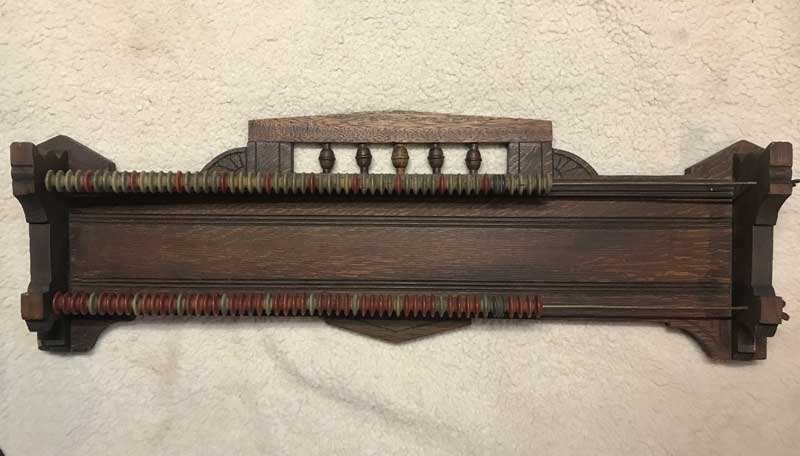
This is a quintessential piece of Victorian “Billiard Americana.” The Eastlake style (named after architect Charles Eastlake) was the height of sophisticated interior design in the 1880s, moving away from the “cluttered” French curves of the mid-century toward the geometric, incised, and honest craftsmanship seen here.
Why this is a Collector’s Choice
Quarter-Sawn Oak: This wasn’t just a budget choice. Quarter-sawing was a premium milling technique that revealed the “flake” or “tiger stripe” grain of the wood. It also made the wood incredibly stable—essential for a scorekeeper where sliding parts need to move smoothly without warping over 140 years.
Eastlake Aesthetic: Look for the characteristic incised lines, “spoon” carvings, and perhaps some ebonized (blackened) details. These were meant to look “modern” and “architectural” in 1880.
The Scale (35″ x 11″): This is a substantial “Statement Piece.” While many scorekeepers were small and utilitarian, a 35-inch oak version was designed to be mounted prominently on the wall of a high-end billiard parlor or Estate.
Functional Anatomy of a 1880s Scorekeeper
In the 1880s, these were typically used for Life Pool, Pyramid Pool, or Carom Billiards.
| Component | Historical Context |
| The Pointers/Sliders | Often made of bone, celluloid, or contrasting wood. They should slide firmly but smoothly. |
| The Numbers | Usually hand-painted or stenciled in a classic “Serif” or “Gothic” font. If they are original and crisp, the value is significantly higher. |
| The Finish | Victorian oak was often finished with orange shellac, which darkens to a rich “honey” or “amber” patina over a century. |
A Preservation Note for Oak
Quarter-sawn oak is very hardy, but the sliding mechanisms can become brittle.
Pro-Tip: If the sliders are sticking, do not use WD-40 or oil. A tiny amount of dry Teflon spray or even a bit of beeswax on the tracks will keep them moving without staining the 140-year-old wood grain.
Please email for price.