(Item 225)
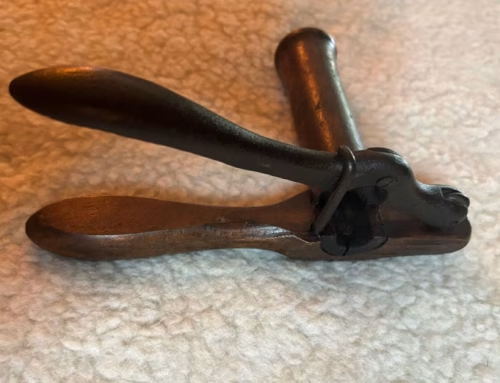
This is the final piece of a true “connoisseur’s” billiards room. While a brush might seem like a utility item, an Antique Brazilian Rosewood and Horsehair brush from the late 19th century is a high-end accessory designed to protect the expensive West of England wool cloth used on professional tables.
1. The Material: Dalbergia nigra (Brazilian Rosewood)
Brazilian Rosewood is the “holy grail” of tonewoods and fine furniture woods.
The Look: It is famous for its “spider-webbing” or “landscape” grain patterns and deep, chocolatey-purple hues.
The Rarity: Since 1992, Brazilian Rosewood has been protected under CITES Appendix I, the strictest level of international trade protection. It is essentially illegal to harvest today.The Weight: It is an incredibly dense, oily wood. In a 12″ brush, the weight of the rosewood helps the person brushing the table apply consistent pressure without having to “push” down, which protects the nap of the cloth.
2. The Bristles: Genuine Horsehair
In the 1880s, high-end brushes used unbleached horsehair (often from the tail) because it is naturally anti-static.
Function: Synthetic bristles can create static electricity that pulls dust into the cloth; horsehair lifts the dust off the cloth.
Taper: Look at the ends of the bristles. A 19th-century “Whisk” or “Table Brush” often has a slight flick or taper at the ends to reach under the cushion rails (the “cappings”).
3. Investment Synergy
Items like this are rarely sold alone for high prices; instead, they act as “Value Multipliers” for a complete antique table set.
A set of Zanzibar balls and a Cox & Yeman scorekeeper are impressive.
Adding the period-correct Brazilian Rosewood brush creates a “Provenance Package.”
- Please email for price.