Item 38
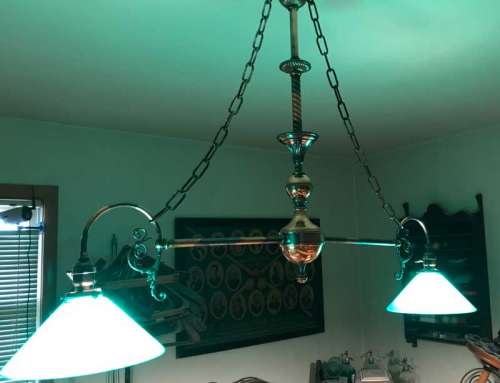
The Sheffield Brass 5-Way represents the “High Victorian” to Edwardian luxury of the 1890s/1910 period.
The Sheffield Distinction
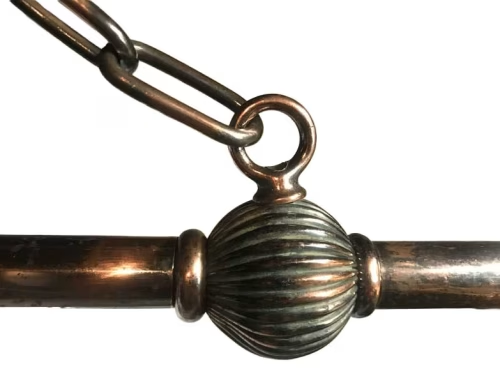
“Sheffield” in this context refers to the specific style of metalwork and “ribbed” (or fluted) design often associated with English silver and brass craftsmanship.
The 5-Way Configuration: A five-lamp setup was the professional standard for a 9-foot or 10-foot table. It ensured that the “shadow” cast by the balls was minimized, providing a perfectly even field of light across the entire slate.
Coordinated Aesthetics: The fact that the 12″ glass shades are ribbed to match the Sheffield body parts indicates this was a custom-ordered “suite.” In the 1890s, high-end billiard rooms were designed as singular aesthetic units where the table, rack, and lighting all shared common design motifs.
Heavy Cast Brass: Unlike the thin, stamped brass of cheaper fixtures, “heavy cast” brass suggests a massive, durable construction. The cast chains and loops aren’t just decorative; they were designed to hold the significant weight of the brass body and five 12-inch glass shades.
Item Profile:
| Feature | Detail | Significance |
| Material | Heavy Cast Sheffield Brass | Premium weight and luster; high-end craftsmanship. |
| Design | 5-Way Ribbed | Provides professional-grade, shadowless lighting. |
| Dimensions | 58″ x 38″ x 36″ | Large footprint; designed for full-size regulation tables. |
| Era | c. 1890s–1910 | Transitions from Victorian “Fancy” to Edwardian Elegance. |
Architectural Impact
At 58″ long, this fixture would have been the focal point of the room. The “ribbed” pattern creates a play of light and shadow on the brass itself, giving the chandelier a shimmering, expensive look even when the lights were turned off.
Please email for price.