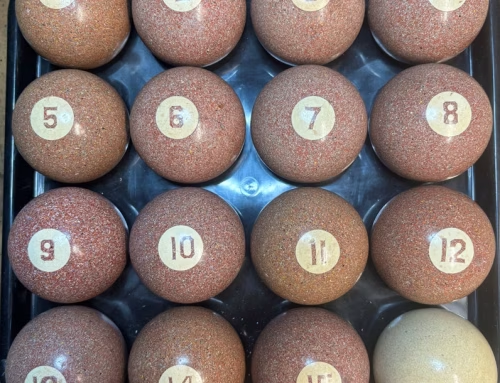
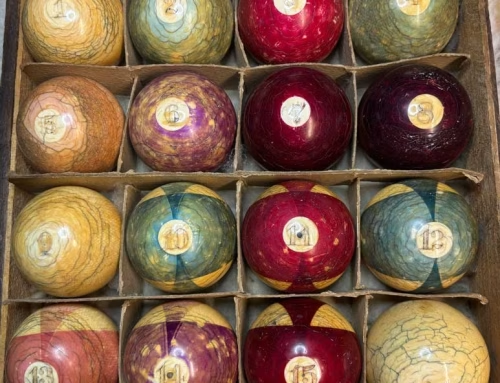
(Item 72)
This represents the pure, minimalist heart of late 19th-century competitive billiards. Unlike the larger 15-ball sets used for “Pool,” a Billiard Ball Set (specifically for Carom or “Four-Ball” games) usually consists of just three or four balls.
In the 1880s, the game of Carom Billiards was considered the “gentleman’s game” of high mathematics and finesse, played on tables without pockets.
The Standard 1880s Billiard Configuration
A set of this era from Brunswick-Balke-Collender typically included:
The Plain White Ball: The cue ball for Player 1.
The Spotted White Ball: The cue ball for Player 2 (featuring a small scrimshawed black dot to tell them apart).
The Red Ball: Often referred to as the “carom” or “object” ball.
Note: Some 19th-century American sets included a second red ball for the game of “Four-Ball.”
Technical & Collector Profile:
| Feature | Detail | Significance |
| Maker | BBC Co. | The ultimate provenance for 19th-century billiard equipment. |
| Material | Solid Ivory | Provides the “natural” elasticity and “click” required for carom shots. |
| Condition | Excellent | Very rare. Ivory balls used in Carom hit each other with high force; finding them without deep “smash marks” is exceptional. |
| Era | 1880’s |
Why “Excellent Condition” is a Premium
In the 1880s, professional billiard players would often have their ivory balls “turned” (reshaved on a lathe) every few months because the ivory would slightly dehydrate and go “out of round.”
Collector’s Note: An “Excellent” set like Item 72 has likely seen very little “turning,” meaning the balls retain their original weight and diameter. This is the most sought-after state for a museum-grade set.
Please email for price.