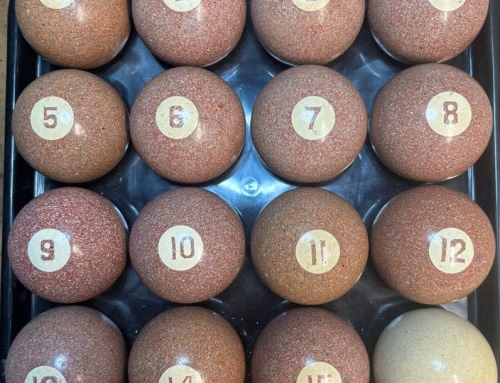
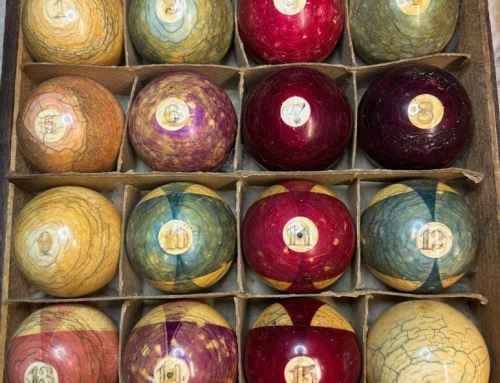
(Item 73)
While the previous sets (Items 74 & 75) were full 15-ball sets for games like “61-pool” or “15-ball,” this Two Ball Set was specifically curated for games like Three-Ball Billiards (Carom), where only two white balls (one with a spot) and one red ball were used.
The Significance of the “Two Ball Set”
In the 1880s, professional matches often focused on Carom Billiards, a game of extreme finesse played on tables without pockets.
The Pairing: Typically, a “Two Ball Set” in ivory consists of two white balls. To differentiate them during play, one ball would feature a small black “spot” or “ring” scrimshawed into the surface—known as the “Spot Ball.”
Material Density: Because Carom requires the balls to travel great distances and click off each other with precision, the ivory used for these sets was often the densest “heart-of-the-tusk” Zanzibar ivory.
The “BBC” Branding: Seeing “BBC” (Brunswick-Balke-Collender) on a two-ball set from the 1880s is particularly rare. Most two-ball pairs were broken up from larger sets or lost over time; finding a matched pair that has stayed together for over 140 years is a rarity.
Item Profile:
| Feature | Detail | Significance |
| Era | Circa 1880s | The peak of the Carom Billiard era in America. |
| Material | Grade-A Ivory | Offers the “natural” hit prized by traditionalists. |
| Condition | “Great Condition” | Implies minimal “pitting” or “flat spots” from heavy impact. |
| Investment Potential | High | Specialized sets (2-ball or 3-ball) are often harder to find than standard 15-ball sets. |
Handling & Conservation
,These balls are sensitive to their environment.
The “Spot” Ball: Check the scrimshawed spot; in “Great Condition” sets, the black pigment should still be dark and centered.
Expansion/Contraction: Avoid moving these balls quickly from a cold storage area to a warm room. The sudden temperature shift can cause ivory to “pop” or develop deep structural cracks.