(Item 59)
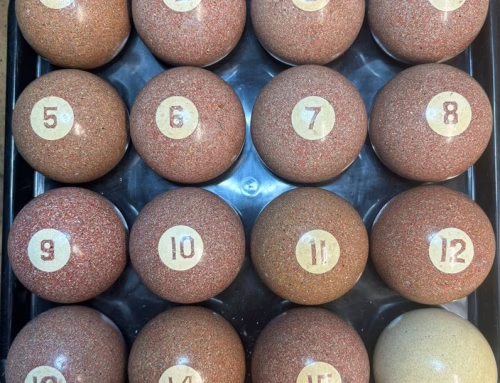
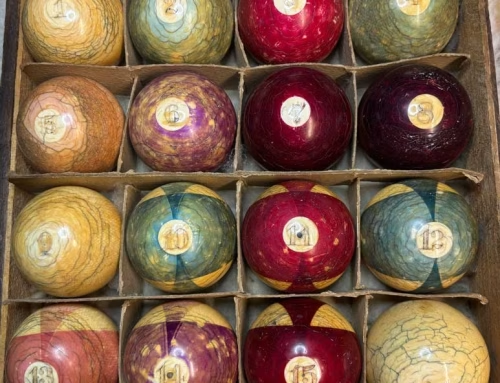
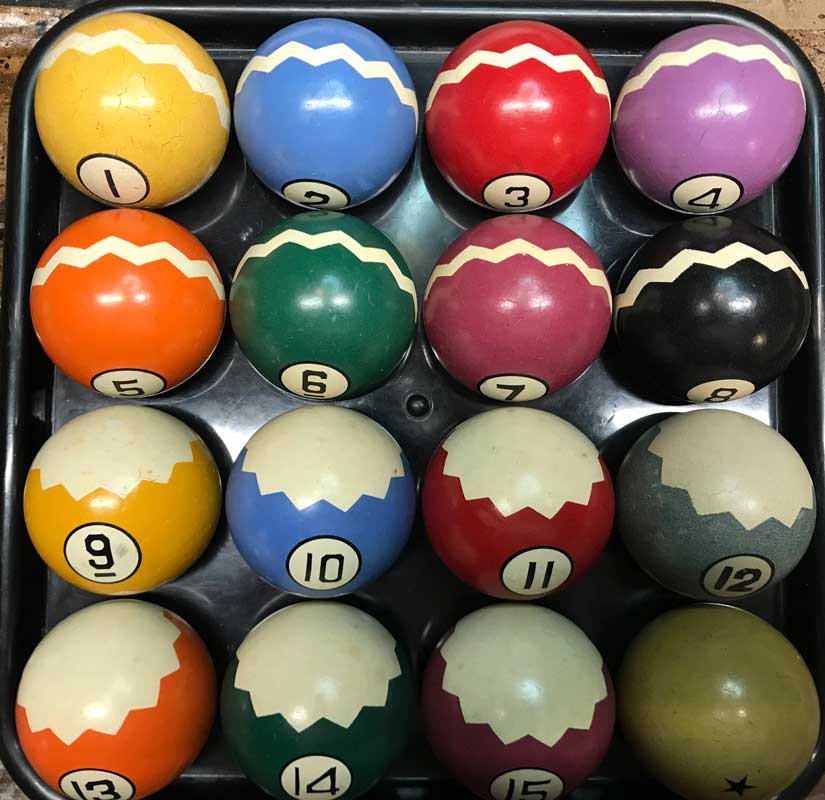
This Antique Clay Zig Zag Pool Ball Set is a wonderful example of the “economy of scale” in the late 19th and early 20th centuries. While ivory was the choice of the elite, clay was the choice of the people. However, finding a complete Zig Zag patterned set with a Star Cue Ball today is significantly more difficult than finding standard clay solids.
The “Zig Zag” Aesthetic
The Zig Zag (or “Sawtooth”) pattern was a specific design choice used to distinguish striped balls from solid balls before the standardization of the broad, flat stripes we see today.
The Pattern: The zig-zag line was often created by a mechanical rolling stamp or a mold that gave the “stripe” a jagged, decorative edge. It reflects the Victorian obsession with making even functional items look ornamental.
The Star Cue Ball: The “Star” cue ball (often called a Liberty Star or Hyatt Star) is the hallmark of the Albany Billiard Ball Company. This star was more than just a decoration; it was a tracking aid. As the ball rolled, the star allowed the player to see the “english” (spin) more clearly.
Material: The Clay Composition
In the 1880s–1910s, “clay” balls were actually a mixture of ground stone, clay, and binders like silicate or shellac.
The Crazing: You mentioned “light crazing.” This is actually a desirable trait for collectors. Crazing—the network of tiny surface cracks—proves the balls are authentic antique clay/composition and not modern resin reproductions. It’s the “fingerprint” of a 100-year-old ball.
Density: Clay balls are heavier and less “elastic” than modern phenolic resin. They have a distinct, muffled “thud” rather than a sharp “click” when they collide.
Preservation of Clay Sets
Clay is porous and sensitive to moisture and oils. To keep them in “hard to find” condition:
| Risk | Mitigation |
| Moisture | Never wash clay balls with water. The moisture can seep into the crazing and cause the ball to swell or even split from the inside out. |
| Cleaning | Use a dry, soft cloth or a very light application of high-quality paste wax to “seal” the surface and prevent the crazing from deepening. |
| Handling | Clay balls can be brittle. Avoid dropping them on hard floors (like tile), as they are more prone to chipping than modern balls. |
Collector’s Note: The “Hyatt” Connection
If the Star Cue Ball is an original Hyatt, it links this set to John Wesley Hyatt, the man who invented Celluloid while trying to win the $10,000 prize for an ivory substitute. The Star Cue Ball is one of the most iconic pieces of “Americana” in the billiard world.
Please email for price.