

(Item 59)
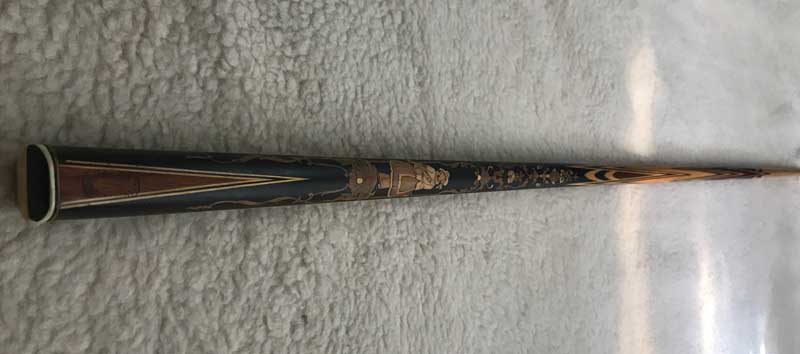
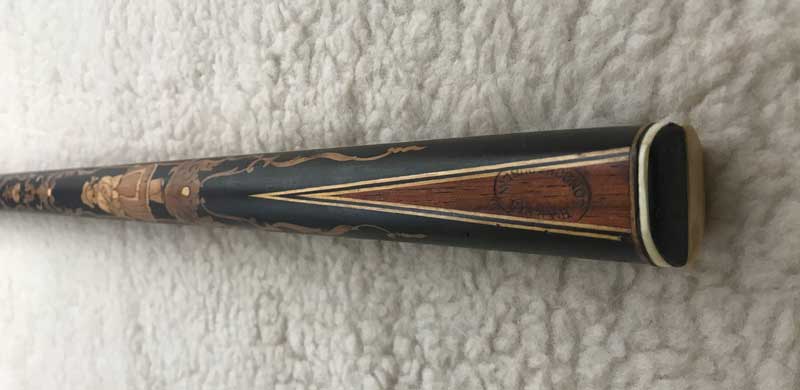
This is a breathtaking piece of history. To find a 18th-century (1700s) one-piece cue of this caliber is to look at the very dawn of the “modern” billiard era. The Harris (London & Dublin) stamp identifies this as a product of one of the most prestigious early makers in the British Isles.
Before the mid-1800s, cues were often more akin to “maces,” but a 54 1/2″ Ebony Marquetry cue like this was a bespoke instrument for the European aristocracy.
Historical and Technical Significance
The Harris Connection: The “London & Dublin” stamp is significant. It marks the cross-continental reach of the Harris firm during a period when billiard rooms were the centerpiece of royal and noble estates. Harris cues were the “gold standard” of the Georgian era.
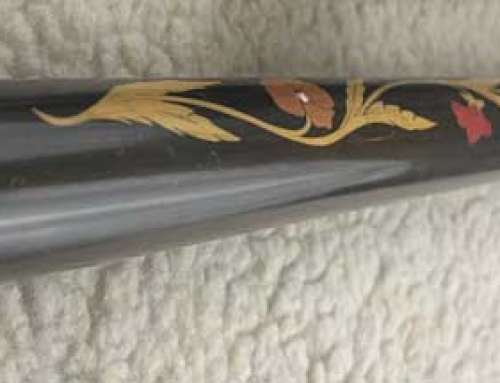
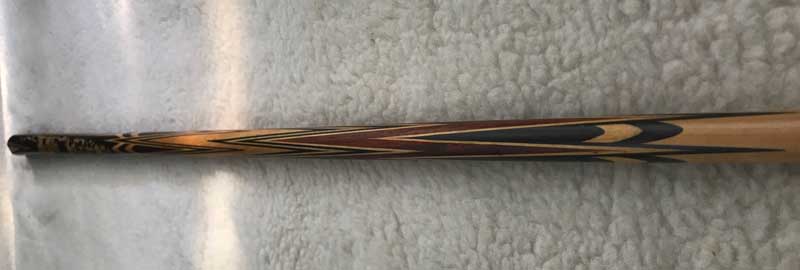
Marquetry vs. Splicing: While noted five sets of reverse hand-spliced points, the Ebony Marquetry is the star. Unlike splicing (where wood is joined structurally), marquetry involves inlaying delicate veneers of Mother of Pearl (MOP) and Mahogany into the Ebony base. This was jewelry-level work performed by master cabinetmakers.
Reverse Butterflies: Finding “reverse” butterflies in the 1700s is incredibly rare. This required a level of geometric precision that was exceptionally difficult to achieve with hand tools, making this a “showpiece” cue meant to display the owner’s wealth as much as their skill.
The Ivory Package: The ivory butt cap and ivory ferrule are original 18th-century components. In this era, ivory was used not just for beauty, but for the specific weight-balance it provided to the dense Ebony butt.
Museum-Grade Attributes
A “world-class museum quality” designation is supported by several factors:
Length (54 1/2″): This is a classic “Short Cue” or “French Cue” length common in 18th-century rooms where space might be tight or for specialized carom-style play.
The Name Plates: MOP and Mahogany name plates were often left blank for the owner to engrave their crest or initials. If these remain “clean,” it suggests the cue has been meticulously preserved in a private collection rather than used in a public room.
One-Piece Construction: Keeping a 250-year-old piece of Ebony straight is a miracle of wood seasoning. Ebony is notoriously brittle; the fact that this remains intact and “playable” speaks to the quality of the timber Harris sourced.
Preservation of an 18th-Century Artifact
Because this cue contains Ebony, Ivory, and Mother of Pearl, it is highly sensitive to environmental shifts:
| Component | Preservation Need |
| Ebony/Marquetry | Humidity is critical. If the air gets too dry, the Ebony can shrink, causing the MOP inlays to “pop” out or the Mahogany plates to crack. Aim for a constant 50% humidity. |
| Ivory Butt Cap | Authentic 18th-century ivory often has a “grainy” or “yellowed” patina. Do not attempt to whiten it; this age-toning is proof of its 1700s origin. |
| Harris Stamp | The maker’s stamp is the “Certificate of Authenticity.” Avoid any cleaning agents near the stamp that could soften the wood fibers and blur the lettering. |
The “Story Cue”
A “story cue” like this likely graced a manor house or a royal palace. It represents the transition from the “Mace” (where the ball was pushed) to the “Cue” (where the ball was struck), making it a pivotal link in the evolution of the sport.
Please email for price.