

The “World Class” Distinction
(Item 62)
When a cue is elevated to “World Class,” it moves beyond being a tool for the game and becomes a Historical Investment. A cue of this caliber generally possesses three specific traits:
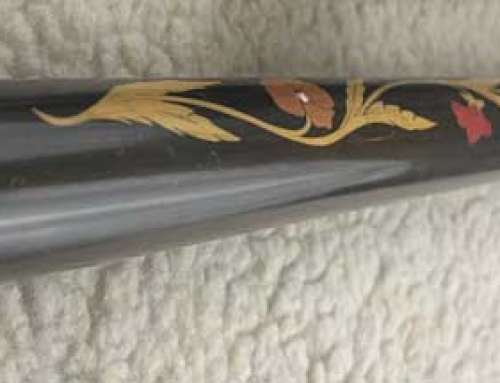
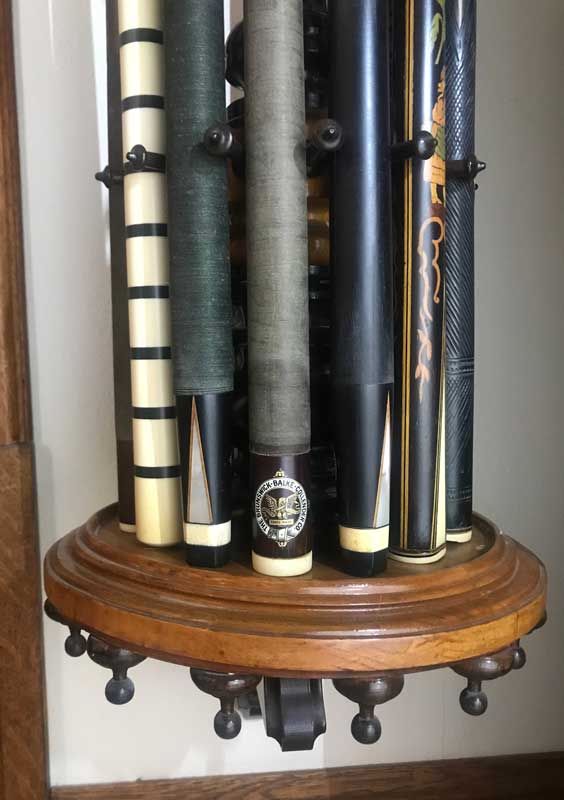
Exotic Materials: Often crafted from Brazilian Rosewood, Ebony, or Curly Maple, often featuring ivory or high-grade “Mother of Pearl” inlays that have aged to a perfect golden patina.
Balance & Physics: Unlike mass-produced cues, these were balanced by hand. They often feature a “taper” that was proprietary to the master maker, designed to deliver a specific “stiffness” required for the Ivory Billiard Balls of the era.
Artistic Integrity: The carving on a Brunswick quality cue is often relief-carved, meaning the wood is sculpted in three dimensions, a feat that modern CNC machines still struggle to replicate with the same soul.
Item Profile: #62
| Feature | Detail | Significance |
| Market Tier | Museum / Private Collection | Not intended for standard play; a preservation-grade asset. |
| Craftsmanship | Hand-Turned / Hand-Inlaid | Represents hundreds of man-hours by a master luthier or cabinet maker. |
| Provenance | Available via Email | High-end cues often have “pedigrees” tracing back to famous 19th-century Billiard Academies. |
| Investment Status | High Appreciation | Antique cues by name-brand makers are currently seeing a surge in “Alternative Asset” markets. |
The Strategy
The “Roll”: Is the cue perfectly straight when rolled on a slate bed?
The Weight: What is the exact weight in ounces (usually between $18\text{ oz}$ and $21\text{ oz}$ for this era)?
The Joint: Is it a one-piece “House Cue” or a two-piece with a hand-cut wooden or brass thread?