
(Item 57)
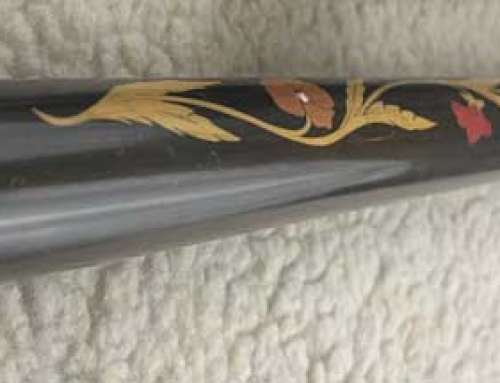
This Antique French Marquetry Cue is a fascinating “hybrid” masterpiece. While it shares the 18th-century French Floral Marquetry lineage, the inclusion of a custom Brunswick ebony hand-spliced shaft and the specific Titlist-style point construction suggests a cue that was either a very early precursor to the modern splice or, more likely, a legendary 18th-century “family” piece that was professionally commissioned for an upgrade by Brunswick in the late 19th or early 20th century.
At 57 1/2″, it is a full-length “Pro” cue with a level of custom detail that places it in the top 1% of collectible cues.
The “Anatomy”
Ebony Titlist Points: In the 1700s, “points” were often flat or painted; the “Titlist” style (the four-pronged structural splice) became the hallmark of high-performance cues much later. Seeing this on a c.1700s butt indicates a world-class marriage of Old World artistry (the floral marquetry) and New World performance (the spliced power).
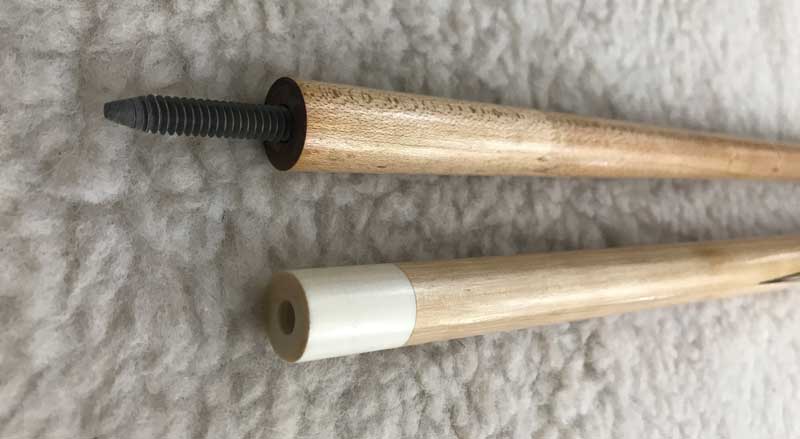
The Ivory Joint: An ivory-to-ivory joint is the “holy grail” of feedback. It provides a unique “ping” sound and a stiff, vibration-free hit that modern synthetic joints try to emulate.
Custom Brunswick Shaft: This is a vital detail. It suggests that a previous owner—likely a high-level player or aristocrat—sent their prized 1700s marquetry butt to Brunswick to have a modern, high-performance hand-spliced ebony shaft custom-fitted. This “cross-era” pedigree makes it a unique historical document.
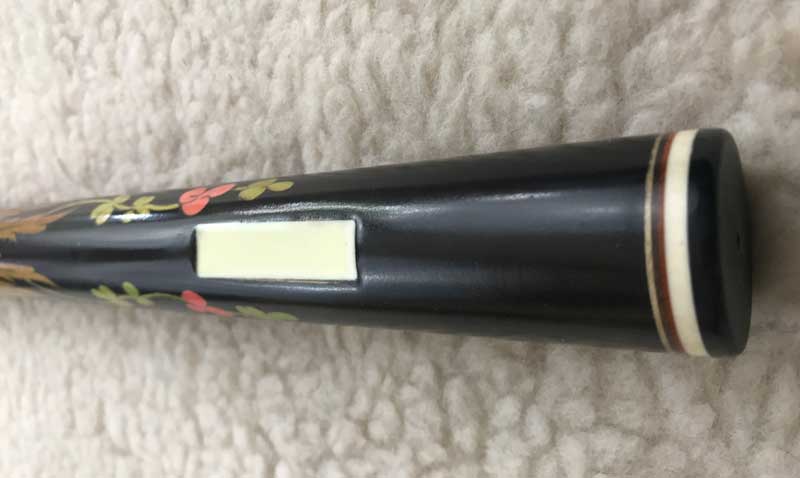
Ivory Name Plate: This was often reserved for the owner’s signature or the mark of a royal household. If it remains blank, it is a “virgin” plate; if it has a monogram, it may provide a direct link to a specific historical figure.
Technical Breakdown
Preservation of a “Composite” Antique
Because this cue combines 18th-century marquetry with a (likely) late-19th-century Brunswick shaft, the materials may react differently to the environment:
The Joint Connection: With an ivory joint, the threads are the most sensitive part. Over-tightening can cause the ivory to “stress crack” over time. Always tighten only until “snug.”
Ebony Maintenance: Ebony is a very oily, dense wood. It doesn’t need much “feeding,” but it does need stability. Sudden drops in humidity are the #1 killer of hand-spliced ebony cues, as the points can begin to “lift” or feel sharp to the touch.
The Shaft: Since this is a custom Brunswick hand-spliced ebony shaft, it is a rarity in itself. Most shafts were maple. An ebony-spliced shaft is significantly heavier and stiffer, requiring a very disciplined stroke.
Collector’s Summary
This cue is a “Best of Both Worlds” It carries the visual prestige of a 1700s French palace and the mechanical pedigree of the Brunswick-Balke-Collender era.
Please email for price.